Which Quality of the Hudson River School Art Is Displayed in This Painting

The Hudson River School was a mid-19th century American fine art movement embodied by a group of mural painters whose aesthetic vision was influenced by Romanticism. The paintings typically depict the Hudson River Valley and the surrounding surface area, including the Catskill, Adirondack, and White Mountains. Works by the second generation of artists associated with the school expanded to include other locales in New England, the Maritimes, the American West, and South America.
Overview [edit]
The name Hudson River School is thought to have been coined by New York Tribune fine art critic Clarence Melt or past landscape painter Homer Dodge Martin.[1] It was initially used disparagingly, every bit the fashion had gone out of favor later the plein-air Barbizon Schoolhouse had come up into vogue among American patrons and collectors.
Hudson River Schoolhouse paintings reflect three themes of America in the 19th century: discovery, exploration, and settlement.[two] They also depict the American landscape as a pastoral setting, where man beings and nature coexist peacefully. Hudson River School landscapes are characterized by their realistic, detailed, and sometimes idealized portrayal of nature, often juxtaposing peaceful agronomics and the remaining wilderness which was fast disappearing from the Hudson Valley just equally it was coming to exist appreciated for its qualities of ruggedness and sublimity.[3] In general, Hudson River School artists believed that nature in the form of the American mural was a reflection of God,[4] though they varied in the depth of their religious conviction. They were inspired by European masters such equally Claude Lorrain, John Constable, and J. Thousand. W. Turner. Several painters were members of the Düsseldorf school of painting, others were educated by German language Paul Weber.[v]
Founder [edit]
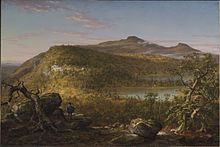
Thomas Cole is generally best-selling as the founder of the Hudson River School.[half-dozen] He took a steamship up the Hudson in the autumn of 1825, stopping first at West Betoken then at Catskill landing. He hiked west high into the eastern Catskill Mountains of New York to paint the showtime landscapes of the expanse. The first review of his work appeared in the New York Evening Mail on Nov 22, 1825.[7] Cole was from England and the brilliant autumn colors in the American mural inspired him.[6] His close friend Asher Brown Durand became a prominent figure in the school, too.[8] A prominent element of the Hudson River School was its themes of nationalism, nature, and property. Adherents of the motility too tended to be suspicious of the economic and technological development of the historic period.[nine]
2nd generation [edit]

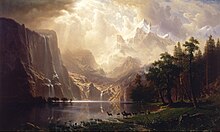
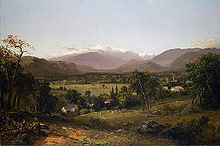

The second generation of Hudson River School artists emerged later on Cole's premature death in 1848; its members included Cole's prize pupil Frederic Edwin Church, John Frederick Kensett, and Sanford Robinson Gifford. Works by artists of this 2d generation are often described as examples of Luminism. Kensett, Gifford, and Church were also amid the founders of the Metropolitan Museum of Fine art in New York City.[10]
Most of the finest works of the second generation were painted betwixt 1855 and 1875. Artists such every bit Frederic Edwin Church and Albert Bierstadt were celebrities during that time. They were both influenced by the Düsseldorf school of painting, and Bierstadt had studied in that metropolis for several years. Thousands of people would pay 25 cents per person to view paintings such every bit Niagara [11] and The Icebergs.[12] The ballsy size of these landscapes was unexampled in before American painting and reminded Americans of the vast, untamed, and magnificent wilderness areas in their country. This was the period of settlement in the American West, preservation of national parks, and establishment of green city parks.
Female artists [edit]
Several women were associated with the Hudson River School. Susie Thousand. Barstow was an avid mountain climber who painted the mountain scenery of the Catskills and the White Mountains. Eliza Pratt Greatorex was an Irish-born painter who was the second woman elected to the National Academy of Design. Julie Hart Beers led sketching expeditions in the Hudson Valley region before moving to a New York City fine art studio with her daughters. Harriet Cany Peale studied with Rembrandt Peale and Mary Blood Mellen was a pupil and collaborator with Fitz Henry Lane.[13] [14]
Legacy [edit]
Hudson River School art has had minor periods of resurgence in popularity. The school gained interest after World War I, probably due to nationalist attitudes. Interest declined until the 1960s, and the regrowth of the Hudson Valley[ vague ] has spurred farther interest in the motility.[15] Historic business firm museums and other sites dedicated to the Hudson River School include Olana Country Historic Site in Hudson, New York, the Thomas Cole National Historic Site in the town of Catskill, the Newington-Cropsey Foundation's historic house museum, art gallery, and research library in Hastings-on-Hudson, New York, and the John D. Barrow Fine art Gallery in the village of Skaneateles, New York.
Collections [edit]
Public collections [edit]
Ane of the largest collections of paintings by artists of the Hudson River School is at the Wadsworth Atheneum in Hartford, Connecticut. Some of the most notable works in the Atheneum's collection are thirteen landscapes past Thomas Cole and 11 by Hartford native Frederic Edwin Church. They were personal friends of the museum'southward founder, Daniel Wadsworth.
Other collections [edit]
- Albany Plant of History & Art in Albany, New York
- Arnot Art Museum in Elmira, New York
- Berkshire Museum in Pittsfield, Massachusetts
- Brooklyn Museum in Brooklyn, New York
- Corcoran Gallery of Art, in Washington, DC
- Crystal Bridges Museum, in Bentonville, Arkansas
- Cummer Museum of Art & Gardens, in Jacksonville, Florida
- Detroit Institute of Arts in Detroit, Michigan
- Fenimore Art Museum in Cooperstown, New York
- Frances Lehman Loeb Art Center, in Poughkeepsie, New York
- Fruitlands Museum in Harvard, Massachusetts
- Gilcrease Museum in Tulsa, Oklahoma
- Haggin Museum in Stockton, California
- Hudson River Museum in Yonkers, New York
- Hunter Museum of American Art in Chattanooga, Tennessee
- Louvre Museum in Paris, France
- Mabee-Gerrer Museum of Art in Shawnee, Oklahoma[sixteen]
- Marsh-Billings-Rockefeller National Historical Park in Woodstock, Vermont
- Metropolitan Museum of Art, in Manhattan, New York
- Museum of Fine Arts, Boston, in Boston, Massachusetts
- Museum of White Mount Art in Jackson, New Hampshire
- National Gallery of Art in Washington, DC
- Newark Museum in Newark, New Jersey
- Newington-Cropsey Foundation in Hastings-on-Hudson, New York
- New-York Historical Society, in Manhattan, New York
- Olana Country Historic Site, in Hudson, New York
- St. Johnsbury Athenaeum, in St. Johnsbury, Vermont
- Westervelt Warner Museum of American Fine art, in Tuscaloosa, Alabama
- Thyssen-Bornemisza Museum, in Madrid, Spain
- The Heckscher Museum of Art, in Huntington, New York
- Virginia Museum of Fine Arts, in Richmond, Virginia
- Worcester Art Museum, in Worcester, Massachusetts
- Wadsworth Atheneum, in Hartford, Connecticut
The Newington-Cropsey Foundation, in their Gallery of Art Building, maintains a research library of Hudson River School art and painters, open to the public by reservation.[17]
Notable artists [edit]
See also [edit]
- Düsseldorf school of painting
- History of painting
- Landscape art
- List of Hudson River Schoolhouse artists
- Macchiaioli
- Romanticism
- National Romanticism
- Western painting
- White Mountain art
- Young America Movement
References [edit]
Notes
- ^ Howat, John Thousand (1987). American Paradise: The World of the Hudson River School. New York: Metropolitan Museum of Fine art, Harry N. Abrams, Inc. pp. 3, four.
- ^ Kornhauser, Elizabeth Mankin; Ellis, Amy; Miesmer, Maureen (2003). Hudson River School: Masterworks from the Wadsworth Atheneum Museum of Art . Wadsworth Atheneum Museum of Art. p. vii. Retrieved June 26, 2016.
- ^ "The Panoramic River: the Hudson and the Thames". Hudson River Museum. 2013. p. 188. ISBN978-0-943651-43-9 . Retrieved June 23, 2016.
- ^ "The Hudson River School: Nationalism, Romanticism, and the Celebration of the American Mural". Virginia Tech History Department. Retrieved June 26, 2016.
- ^ John K. Howat: American Paradise: The World of the Hudson River School, S. 311
- ^ a b O'Toole, Judith H. (2005). Different Views in Hudson River School Painting. Columbia University Press. p. 11.
- ^ Boyle, Alexander. "Thomas Cole (1801–1848) The Dawn of the Hudson River School". Hamilton Sale Galleries. Retrieved nineteen December 2012.
- ^ "Asher B. Durand". Smithsonian American Art Museum: Renwick Gallery. Smithsonian Museum. Retrieved June 26, 2016.
- ^ Angela Miller, The Empire of the Eye (1996); Alfred 50. Brophy, Holding and Progress: Antebellum Landscape Fine art and Property, McGeorge Law Review 40 (2009): 601-59.
- ^ Avery, Kevin J. "Metropolitan Museum of Fine art: Frederick Edwin Church". Metropolitan Museum of Art. Retrieved 19 December 2012.
- ^ "Corcoran Highlights: Niagara". Corcoran Museum of Fine art. Archived from the original on 15 July 2011. Retrieved 19 December 2012.
- ^ Potter, Russell A. "Review of 'The Voyage of the Icebergs: Frederic Edwin Church's Arctic Masterpiece'". Rhode Island College. Retrieved 19 Dec 2012.
- ^ Dobrzynski, Judith H. "The G Women Artists of the Hudson River Schoolhouse". Smithsonian. Retrieved 28 May 2013.
- ^ "Recall the Ladies: Women Artists of the Hudson River Schoolhouse". Resource Library. Traditional Fine Arts System, Inc. Retrieved 28 May 2013.
- ^ Zimmer, William (Oct 17, 1999). "Hudson River School But Keeps on Rolling". The New York Times . Retrieved May xv, 2018.
- ^ White, Mark Andrew (2002). Progress on the Land: Industry and the American Landscape Tradition. Oklahoma Metropolis, OK: Melton Art Reference Library. pp. 6–13. ISBN0-9640163-1-1.
- ^ Hershenson, Roberta (Nov 7, 1999). "Piece of work Is in Dispute, only Cropsey'southward Home Is Open up". The New York Times . Retrieved Apr 29, 2018.
- ^ Encyclopedia Britannica
- ^ Allaback, Sarah. "19th Century Painters: Hudson River School" (PDF). 2006. Hudson River Valley National Heritage Area. Archived from the original (PDF) on 16 May 2013. Retrieved 19 December 2012.
- ^ Rickey, Frederick. "Robert W. Weir (1803–1889)". United States War machine Academy. Archived from the original on 29 September 2012. Retrieved 19 December 2012.
Sources
- American paradise: the world of the Hudson River school . New York: The Metropolitan Museum of Art. 1987. ISBN978-0-87099-496-viii.
- Avery, Kevin J., & Kelly, Frank (2003). Hudson River schoolhouse visions: the landscapes of Sanford R. Gifford . New York: The Metropolitan Museum of Art. ISBN978-0-300-10184-iii.
{{cite book}}: CS1 maint: multiple names: authors list (link) - Ferber, Linda Southward. The Hudson River School: Nature and the American Vision. New-York Historical Guild, 2009.
- Sullivan, Marker W. The Hudson River School: An Annotated Bibliography. Metcuhen, NJ; Scarecrow Press, 1991.
- Wilmerding, John. American Low-cal: The Luminist Motility, 1850–1875: Paintings, Drawings, Photographs. National Gallery of Art, Washington, D.C., 1980. ISBN 9780064389402. OCLC 5706999.
External links [edit]
- The Hudson River School, American Art Gallery
- The Hudson River Schoolhouse, The Metropolitan Museum of Art
- National Park Service overview of Hudson River School
- Wadsworth Atheneum's Hudson River School Collection
Source: https://en.wikipedia.org/wiki/Hudson_River_School
0 Response to "Which Quality of the Hudson River School Art Is Displayed in This Painting"
Post a Comment